
Technical drawing extraction is the project I want to show today: an automotive plant now reads its forging drawings automatically, with no typist in the loop. The whole technical drawing extraction pipeline runs offline, on the plant’s own server, because the drawings are confidential. In short, technical drawing extraction here means an on-prem AI model that reads a PDF and writes clean data straight into the ERP.
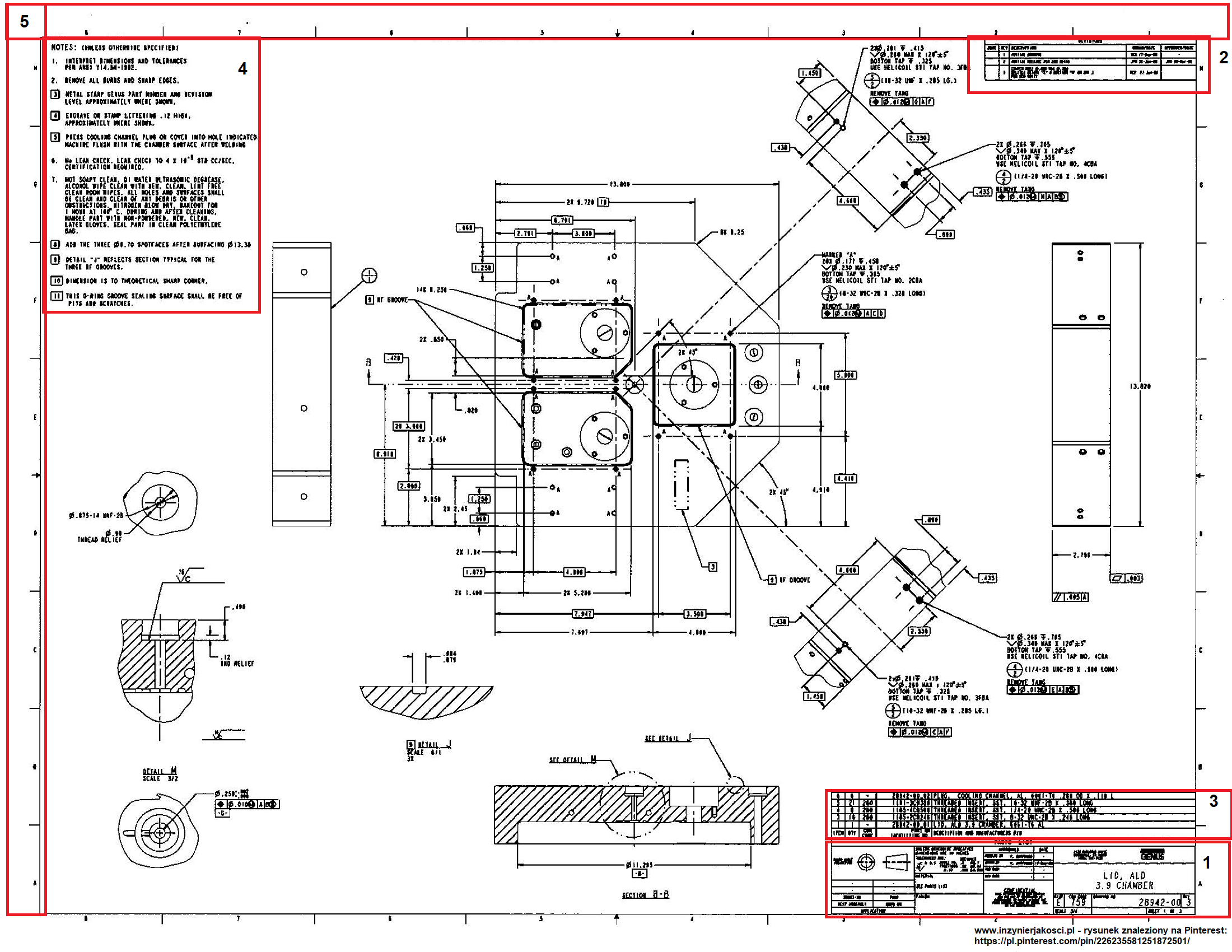
This sheet alone holds a notes block, a title block, dozens of tolerances and several section views. A person needs minutes to copy it by hand. The model does the same job in seconds.
What technical drawing extraction actually does
The plant receives supplier drawings as PDFs. Each sheet packs a title block, a material spec, tolerances and a notes list. Therefore the data exists, yet it stays locked inside an image.
From PDF to structured fields
The system renders every PDF page at 300 DPI. Then it crops the title block and reads it first. Finally it scans the full sheet for the overall geometry. In practice the output is clean JSON, ready for any downstream system.
The model pulls these fields from each sheet:
- drawing number, product number, revision, author and date,
- material grade, forging mass and material-consumption norm,
- surface roughness, heat treatment and hardness,
- length, width, thickness and angle tolerances,
- overall dimensions in millimetres, plus the parts list.
Why technical drawing extraction must run offline
Automotive drawings are trade secrets. For example, a tier-1 supplier may not send a single dimension to a public cloud. Therefore cloud OCR services were ruled out from day one.
Air-gapped, on-premise inference
So the whole model lives on a server inside the plant. No drawing ever leaves the building. Meanwhile the IT team keeps full control of the hardware, the weights and the logs. By contrast, a SaaS tool would push every sheet to someone else’s data centre.
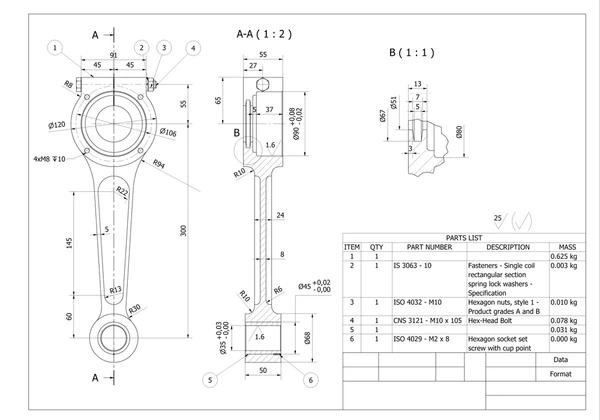
Take this connecting-rod sheet. It carries a full parts list with item, quantity, part number, description and mass. The model reads that table too, row by row.
The AI behind technical drawing extraction
The engine is an open-weight vision-language model, Qwen2.5-VL, served locally through Ollama. In addition, the model needs no internet and runs on the plant’s own GPU or Apple Silicon box.
A multi-pass vision-language pipeline
The pipeline reads each sheet in three passes that run in parallel. One pass handles the title block. Another reads material, tolerances and notes. A third measures the overall geometry. Moreover, the model first transcribes the raw text, then parses its own notes, which kills most hallucinations on tiny dimensions.
Units are messy on real drawings. Therefore the system converts inches to millimetres and pounds to kilograms on the fly.
Technical drawing extraction feeding your ERP
Reading a sheet is only half the job. The data must land where planners actually work, namely the ERP. Therefore the JSON maps onto the master-data fields of whatever suite the plant runs.
SAP, IFS, Oracle and the rest
Manufacturing is the single largest ERP market segment. As a result, most plants run one of a handful of suites:
- SAP S/4HANA — the largest ERP by customer base,
- Oracle Fusion Cloud ERP and NetSuite,
- Microsoft Dynamics 365,
- Infor CloudSuite Industrial and IFS Cloud,
- Epicor Kinetic.
In practice the extracted fields become a material master, a routing input or a quoting record. Consequently the planner stops retyping and starts checking.
Cost: technical drawing extraction custom vs licensed
Scope: one plant, supplier PDFs, an offline model and export to a single ERP. Horizon: three years.
| Cost item | Licensed cloud IDP + manual checks | Custom offline build with me |
|---|---|---|
| Per-document cloud fees (year 1) | 30 000 – 90 000 PLN | 0 PLN — your own model |
| Setup, connectors, ERP mapping | 40 000 – 120 000 PLN | Included in the project |
| One-off offline build (reader + ERP export) | — | 25 000 – 45 000 PLN net |
| Data leaves the plant? | Yes — to the cloud | No — fully offline |
| Years 2–3 fees + support | 80 000 – 220 000 PLN | 0 PLN (optional support ~8 000 PLN/yr) |
| 3 years total | 150 000 – 430 000 PLN | 25 000 – 60 000 PLN |
In short, the custom build pays for itself long before a licensed IDP subscription would.
How to start with technical drawing extraction
- Pick one drawing format with the highest volume.
- Define the exact fields your ERP needs as master data.
- Stand up the offline model on a single in-house server.
- Validate the JSON against 50 known sheets before go-live.
- Wire the export into SAP, IFS or your own ERP.
If this sounds like your shop floor, see rsmobile.net — most projects start with one drawing format and one ERP target.
Summary — technical drawing extraction in automotive
Technical drawing extraction turns confidential PDFs into ERP-ready data without sending anything to the cloud. The model reads the title block, the tolerances and the parts list, then exports straight into SAP or IFS. For a single automotive plant, that path is faster, cheaper and safer than both manual typing and a licensed cloud service.
Further reading: SAP S/4HANA on Wikipedia.
Related guides:

LATEST POSTS